|
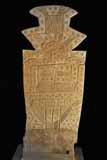
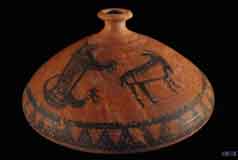
Indus Valley Division This collection has been divided into 5 parts to reduce page loading times: The Indus Valley Civilization (3300 - 1700 BC), abbreviated IVC, was an ancient civilization that flourished in the Indus River basin. Primarily centred in Pakistan (Sindh and Punjab provinces) and India (Gujarat and Rajasthan), it extended westward into the Balochistan province of Pakistan. Remains have been excavated from Afghanistan, Turkmenistan and Iran, as well. Development of farming communities ultimately jed to the accretion of larger settlements from the later 4th millennium BC. The distinctive regional culture which emerged is called Early or Pre-Harappan. The mature phase of this civilization is technically known as the Harappan Civilization (2600 - 1900BC), after the first of its cities to be unearthed: Harappa in Pakistan. Excavation of IVC sites have been ongoing since 1920, with important breakthroughs occurring as recently as 1999. Most painted pottery of the Indus cities was covered with a red slip (the colour coming from red ochre) and then painted with black designs. Around 2600 BC the style of the painted designs included floral and geometric motifs arranged in panels beginning at the rim and extending to the lower body of the vessel. Many of these painted designs such as the pipal leaf, the fish-scale design and intersecting-circle motifs have roots in earlier regional cultures (3300 - 2600 BC) but the combination of various motifs and the style of the decoration reflects a new synthesis characteristic of the Indus cities. |
|
_________________________________________________________________________________________________________________________
|