|
| |
Sponges (Porifera) Division
Porifera
translates to "Pore-bearer"(from
Latin
porus
"pore" and
ferre "to
bear"). They are primitive,
sessile,
mostly
marine, water
dwelling
filter feeders
that pump water through their bodies to filter out particles of food matter.
Sponges represent the
simplest of
animals. With no true tissues (parazoa),
they lack
muscles,
nerves, and
internal
organs. Their
similarity to colonial
choanoflagellates
shows the probable evolutionary jump from
unicellular to
multicellular
organisms. However, recent genomic studies suggest they are not the most ancient
lineage of animals, but may instead be secondarily simplified though the
fossil record
of sponges dates back to the
Neoproterozoic
Era.
Class: Demospongiae
The Demospongiae are the
largest
class in the
phylum
Porifera.
Their "skeletons"
are made of
spicules
consisting of fibers of the protein
spongin, the
mineral
silica, or
both.
Subclass: Ceractinomorpha
Order: Monaxida
Family: Choiidae
Genus: Choia

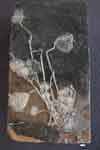
Image Code F3544 |
Catalogue No.: F3544
Description:
Fossil
Demosponge, Choia utahensis.
Wheeler
Formation. Millard County, Utah, USA. Middle Cambrian Period.
Choia lived on the seafloor
unattached and filtered food particles from the water. Choia are very rare
in the Burgess Shale, and not very common in Cambrian strata of Utah as
well.
Size: 104 x 76mm. |
Order:
Lithistida
Family:
Scytaliidae
Genus:
Stachyspongia

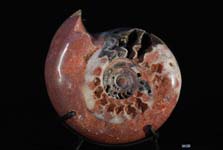
Image Code F3634 |
Catalogue No.: F3634
Description:
Opalised sponge fossils, Stachyspongia
neoclavellata. Pallingup Siltstone. Esperance, Western Australia. Upper Eocene
Epoch. 15 pieces. Opal
is a mineraloid gel which is deposited at relatively low temperature and may
occur in the fissures of almost any kind of rock, being most commonly found
with limonite, sandstone, rhyolite, and basalt. Opal is one of the
mineraloids that can form or replace fossils.
Size: Average of 60 x 24mm. |
Class:
Hexactenellida
Hexactinellid sponges
are sponges with a skeleton made of four- and/or six-pointed silaceous spicules,
often referred to as glass sponges.
Order:
Lithistida

Image Code F3631 |
Catalogue No.: F3631
Description: Lithistid Sponge fossil, (species undeterminable). Pallinup Siltsone, Esperance, Western Australia. Upper
Eocene Epoch. 2 pieces.
Size: Average of 61 x 35mm. |
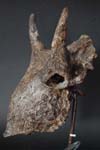
Order: Choristida?

Image Code F3632 |
Catalogue No.: F3632
Description: Fossil sponge of the order Choristida?
Pallingup Siltstone. Esperance, Western Australia. Upper Eocene Epoch. 2
pieces.
Size: Average of 76 x 57mm. |
Phylum: (uncertain)
Family: Chancelloriidae.

Image Code F631 |
Catalogue No.: F631
Description:
Armoured Sponge-like
fossil, Chancelloria pentacta.
This
complete specimen is rare and valuable, as many of these fossils consist
only of spines and other fragments. Classifying the chancelloriids is
difficult. Some paleontologists, including modern ones, classify them as
sponges, an idea which chancelloriids' sessile lifestyle and simple
structure make plausible. Other proposals suggest that they were more
advanced, or at least originated from more advanced ancestors; for example
chancelloriids' skins appear to be much more complex than those of any
sponge. It has been suggested that chancelloriids were related to the "chain
mail" armored slug-like
halkieriids,
which are important to
paleontologists'
view of the evolution of
multi-celled
animals in analyses of the
Cambrian explosion.
Middle
Cambrian. Wheeler Shale Millard County, Utah. While originally described as
a sponge, some scientists have proposed a new Class Coeloscleritophora for
Chancelloria. This Class includes Wiwaxiidae and other Cambrian
sclerite-bearing animals.
Size: 95 x 120mm. |
Return to Top
|